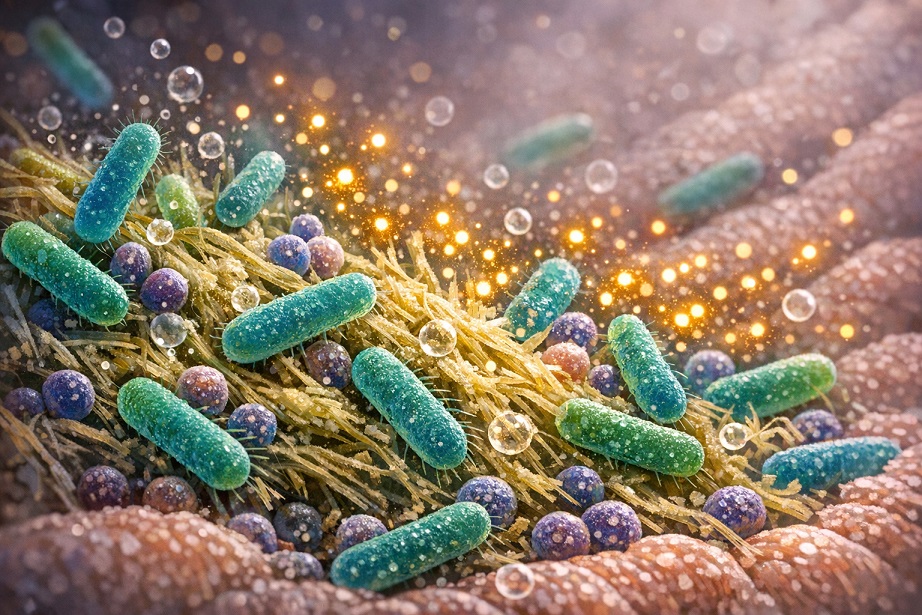
Here is a fact that most people find unsettling when they first encounter it: Candida albicans, the fungal organism responsible for yeast infections, oral thrush, and in severe cases systemic fungal disease, is present in the guts of a majority of healthy adults. So is Escherichia coli, the bacteria most commonly associated with food poisoning and urinary tract infections. They are there right now, in most readers of this article, and they are not causing problems. Not today, and likely not tomorrow either.
The question of why these potentially harmful organisms are present but contained is one of the most revealing questions in gut microbiology. The answer illuminates something fundamental about how the gut ecosystem works, what makes it protective under normal conditions, and what makes it vulnerable when those normal conditions break down. The answer, in short, is that beneficial bacteria, particularly Bifidobacterium, are keeping the Candida and E. coli and dozens of other opportunistic organisms in check through mechanisms that are continuous, specific, and deeply consequential for health.
Candida in the Gut: A Conditional Threat
Candida albicans is a commensal organism in the gastrointestinal tracts of somewhere between 40 and 80 percent of healthy adults. At these colonization levels, in a gut with a healthy microbial community, it causes no symptoms and no harm. It exists as a yeast form, reproducing slowly and maintaining low population levels in the competitive environment created by the dominant bacterial community. It is essentially suppressed below the threshold of clinical significance by the collective activity of the beneficial bacteria around it.
Candida’s pathogenic potential emerges under specific conditions. When the microbial community is disrupted, most commonly by antibiotic treatment that kills bacteria without targeting fungi, Candida faces suddenly reduced competition. With bacterial populations eliminated or severely reduced, Candida can proliferate rapidly, convert from the yeast form to a more invasive hyphal form with root-like structures that penetrate tissue, and establish the overgrowth associated with symptomatic candidiasis. The same organism that was living harmlessly in the gut becomes problematic not because it changed but because the ecological conditions governing its behavior were disrupted.
pH as the Primary Containment Mechanism
The most important mechanism by which beneficial gut bacteria contain Candida is pH regulation. Candida albicans has optimal growth and virulence at pH values above 6.0, preferring the near-neutral to mildly alkaline conditions that prevail when beneficial bacterial fermentation is low. At the mildly acidic pH of 5.5 to 6.0 that robust Bifidobacterium activity maintains through lactic acid production, Candida’s growth rate is substantially reduced and its ability to transition to the more virulent hyphal form is impaired.
Research examining the relationship between colonic pH and Candida colonization has found that individuals with lower colonic pH, reflecting higher beneficial bacterial fermentation activity, show lower Candida colonization levels than those with higher pH values. This association reflects the direct inhibitory effect of the acidic environment on Candida growth, demonstrating that the pH maintenance provided by Bifidobacterium is not merely beneficial for digestion and mineral absorption. It is a primary containment mechanism for one of the gut’s most significant potential pathogens.

E. Coli: Present But Managed
Escherichia coli is a normal and indeed necessary component of the human gut microbiome. Most E. coli strains are completely harmless commensals that contribute to the ecological balance of the gut and perform useful metabolic functions. The strains responsible for disease, including enterotoxigenic E. coli causing traveler’s diarrhea, enterohaemorrhagic E. coli causing bloody diarrhea and kidney failure, and uropathogenic E. coli causing urinary tract infections, are typically minority populations even in people who harbor them, held in check by the dominant beneficial microbial community.
Competitive Exclusion: No Room for Overgrowth
The primary mechanism by which beneficial bacteria contain problematic E. coli strains is competitive exclusion. In a gut where Bifidobacterium and other beneficial bacteria are abundant, actively fermenting available substrates, and occupying mucosal adhesion sites with their own populations, the ecological space and nutritional resources that pathogenic E. coli strains would need to establish overgrowth simply are not available. Every molecule of fermentation substrate consumed by Bifidobacterium is one less molecule available to E. coli. Every mucosal adhesion site occupied by Bifidobacterium is one less site where E. coli can establish the mucosal attachment it needs to produce toxins in proximity to epithelial cells.
The acidic environment produced by Bifidobacterium fermentation adds a direct chemical suppression layer to this competitive exclusion. E. coli’s optimal growth pH is near-neutral to slightly alkaline, and both the growth rate and the toxin production capacity of enterotoxigenic E. coli strains are significantly reduced at the acidic pH that robust Bifidobacterium activity maintains. This multi-layered containment strategy, combining competition for substrate, competition for adhesion sites, and chemical acid suppression, keeps pathogenic E. coli strains at population levels below the threshold of clinical significance in a healthy gut.
The Disruption Scenarios: When Containment Fails
Understanding how beneficial bacteria contain Candida and E. coli makes it easier to understand why disruption of those bacterial populations so reliably leads to problems with these organisms. The scenarios in which containment most commonly fails follow predictably from the mechanisms that normally maintain it.
Antibiotic Use
Antibiotic-associated Candida overgrowth is one of the most common side effects of antibiotic therapy precisely because antibiotics eliminate the bacterial containment mechanisms while leaving Candida unaffected. The ecological void left by antibiotic-killed bacteria is filled by the remaining organisms capable of proliferating in the changed environment, and Candida, with no antibiotic to suppress it and no bacterial competition to contain it, is often among the primary beneficiaries. Oral and vaginal thrush following antibiotic courses are well-known clinical manifestations of this predictable ecological disruption.
Dietary Factors
Diets very high in simple sugars create a nutrient environment that preferentially supports Candida growth while simultaneously failing to provide the fermentable fiber that supports the beneficial bacterial populations that would otherwise contain it. Candida ferments simple sugars more efficiently than most gut bacteria, meaning a high-sugar diet shifts the nutritional competitive advantage toward Candida in a way that a fiber-rich diet does not. This is the biological basis behind the dietary advice to reduce sugar intake for managing Candida overgrowth, though it is most effective when combined with active support for the beneficial bacterial populations through prebiotic fiber.
Rebuilding the Defense
When Candida or problematic E. coli populations have increased due to antibiotic treatment, poor diet, or other disruptions, the most ecologically coherent restoration strategy is rebuilding the Bifidobacterium community that provides the primary containment mechanisms. Inulin-FOS from chicory root selectively nourishes Bifidobacterium, enabling it to expand its populations, resume robust lactic acid production, reacidify the gut environment, and reoccupy the mucosal adhesion sites that competitor organisms may have partially claimed during the disruption period.
This is not a quick process. Restoring meaningful Bifidobacterium dominance after significant disruption takes weeks of consistent prebiotic support, and the pathogens being suppressed do not give up their newly acquired ecological position instantly. But the direction of the process is reliable, and with consistent prebiotic nutrition, the ecological conditions that favor Bifidobacterium over Candida and pathogenic E. coli are progressively restored. The organisms that were always present but contained can return to being present but contained once more.