
Color in the natural world is rarely accidental, and in the context of nutrition, it is often a reliable signal of biological value. The yellows, oranges, and reds that dominate autumn landscapes, tropical fruits, and the flesh of wild salmon all share a common chemical ancestry: they’re expressions of the carotenoid family, a group of over 700 pigment compounds that are among the most widely distributed and functionally important molecules in the living world.
For the human eye, carotenoids are not a peripheral nutritional consideration. They are the chemical foundation of the retina’s primary protective architecture. Of the roughly 20 carotenoids that circulate in human blood, the eye selectively concentrates specific ones in specific locations for specific purposes. Understanding which carotenoids matter most for eye health, how each one contributes, and why the full spectrum outperforms any single compound gives a genuinely useful framework for thinking about vision nutrition.
What Carotenoids Are and How They Work
Carotenoids are fat-soluble pigments synthesized by plants, algae, and certain bacteria. Animals, including humans, cannot manufacture them and must obtain them entirely through diet. After absorption from the digestive tract, they’re transported through the circulation and deposited in various tissues, with some showing remarkable specificity for particular organs.
Their biological utility stems from two closely related properties. First, they absorb specific wavelengths of light with high efficiency, which allows them to function as optical filters in tissues where controlling light exposure matters. Second, this same ability to interact with light energy gives them potent antioxidant activity: they can quench the reactive oxygen species that high-energy light exposure generates, including the particularly damaging singlet oxygen molecule that forms when photons are absorbed by biological tissue.
The Two Carotenoid Subfamilies
The carotenoid family is divided into two main groups with different biochemical properties. Carotenes, the purely hydrocarbon compounds, include beta-carotene and lycopene. Xanthophylls, which contain oxygen atoms in their structure, include lutein, zeaxanthin, meso-zeaxanthin, and astaxanthin. This distinction matters practically because xanthophylls are generally more polar than carotenes and distribute differently in biological tissue. The xanthophylls are overwhelmingly dominant in the eye’s carotenoid profile, which reflects their superior performance in the specific biochemical environment of the retina.
Lutein and Zeaxanthin: The Macular Specialists
Among all carotenoids, lutein and zeaxanthin occupy the most clearly defined and critical role in eye health. They are the only carotenoids that the body specifically deposits in the macula, accumulating to concentrations hundreds of times higher than those found in any other tissue.
Their distribution within the macula is spatially precise. Zeaxanthin dominates at the foveal center, where cone photoreceptors are most densely packed and where the sharpest central vision occurs. Lutein covers the broader peripheral macula in a protective ring around the foveal core. Together they form the macular pigment, a physical optical filter that absorbs incoming blue light before it can generate the free radicals that damage photoreceptor cells and retinal pigment epithelium over time.
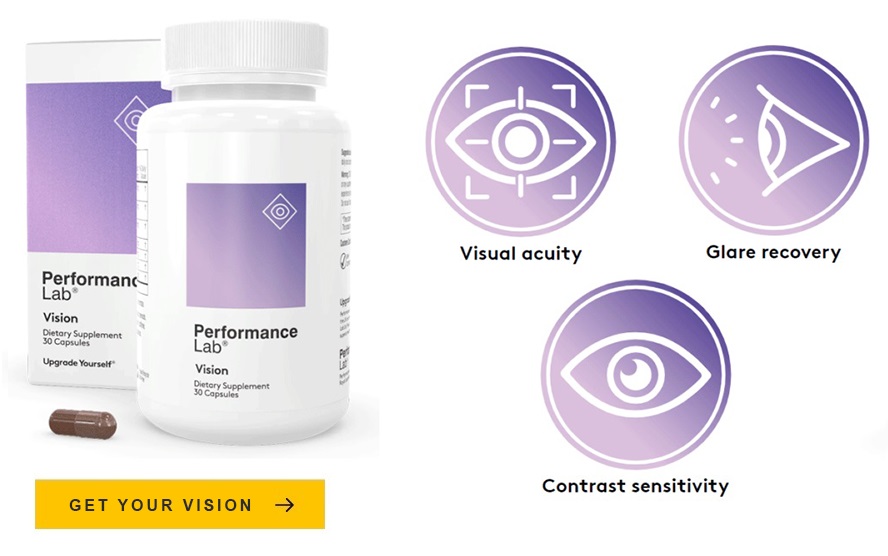
The clinical evidence for their importance is substantial. The landmark AREDS2 trial demonstrated a 26% reduction in advanced AMD progression risk with combined lutein and zeaxanthin supplementation. Multiple studies link higher Macular Pigment Ocular Density (MPOD) to better visual acuity, contrast sensitivity, glare recovery, and reduced AMD risk. No other carotenoids have a comparable body of clinical evidence specifically for macular health.
Meso-Zeaxanthin: The Third Macular Carotenoid
A third compound, meso-zeaxanthin, is a structural isomer of zeaxanthin that concentrates at the foveal center alongside zeaxanthin itself. It is not obtained directly from food in meaningful amounts. Instead, the retina produces it locally through enzymatic conversion from lutein, using dietary lutein as the raw material. Its presence reinforces the carotenoid density at the most vulnerable point in the macula, and inadequate lutein intake, by limiting the substrate for this conversion, can reduce meso-zeaxanthin levels even when zeaxanthin intake is adequate.
Astaxanthin: The Circulation and Fatigue Specialist
Astaxanthin is a keto-carotenoid produced by the microalgae Haematococcus pluvialis, and it holds a distinctive place in the carotenoid-eye health story for reasons that are quite different from lutein and zeaxanthin’s macular pigment contributions.
Unlike lutein and zeaxanthin, which concentrate in the macular pigment as structural components, astaxanthin distributes more broadly in retinal tissue after crossing the blood-retinal barrier. Its most clinically significant documented role is the improvement of retinal microcirculation: multiple studies have found that astaxanthin supplementation increases blood flow velocity in retinal capillaries, improving the delivery of oxygen and nutrients to the photoreceptors and supporting cells that depend on this supply.
Astaxanthin has also been studied specifically for its effects on accommodative fatigue, the ciliary muscle strain that drives digital eye strain in screen users. Several randomized controlled trials have found improvements in accommodative function and reductions in subjective eye fatigue with regular astaxanthin supplementation, making it one of the more practically relevant carotenoids for the modern screen-dominated lifestyle.
From a pure antioxidant standpoint, astaxanthin is also among the most potent singlet oxygen quenchers known, and its molecular structure allows it to span the full width of cell membranes, providing simultaneous antioxidant protection on both the interior and exterior surfaces of retinal cells.
Beta-Carotene: The Foundation, Not the Summit
Beta-carotene, the carotenoid most people associate with eye health through the cultural mythology of carrots, serves a more foundational than specialized role in vision. It’s a provitamin A carotenoid, meaning the body converts it to retinol (vitamin A) as needed. Retinol is the precursor to retinal, the light-absorbing component of rhodopsin, the rod cell protein that enables night vision and dark adaptation.
Vitamin A deficiency produces night blindness, one of the earliest and most sensitive clinical signs of this nutritional shortage. In populations where vitamin A deficiency is common, beta-carotene-rich foods are critically important. In well-nourished Western populations, however, frank vitamin A deficiency is rare, and the eye health limitations most people face are not in the rhodopsin system but in macular pigment density, retinal circulation, and oxidative stress management, areas where lutein, zeaxanthin, and astaxanthin are far more relevant.
The Spectrum Advantage
The case for the full carotenoid spectrum rather than any single compound rests on two complementary arguments: complementary mechanisms and complementary tissue coverage.
Complementary Mechanisms
Lutein and zeaxanthin filter blue light and provide lipid-phase antioxidant protection in the macular pigment. Astaxanthin provides membrane-spanning cellular protection and circulation support throughout the retina. Beta-carotene supplies the vitamin A substrate for rhodopsin in the rod cells. Each of these functions addresses a different vulnerability in the visual system, and none of the others provide adequate backup for the one they don’t cover. A nutritional strategy that focuses exclusively on lutein and zeaxanthin, however well-dosed, leaves the circulatory and accommodative support that astaxanthin provides unaddressed.
Complementary Tissue Coverage
Different carotenoids reach different anatomical locations within the eye. Lutein and zeaxanthin are highly concentrated in the macula. Astaxanthin distributes more broadly in the retina. Vitamin A-derived retinal is present in rod photoreceptors throughout the peripheral retina. Comprehensive retinal protection, across the full three-dimensional anatomy of the eye, requires the contributions of multiple carotenoids operating at their respective locations.
Getting the Full Spectrum
Diet provides carotenoids in varying combinations depending on which foods dominate a person’s intake. Dark leafy greens are rich in lutein; eggs provide bioavailable lutein and zeaxanthin; orange and yellow vegetables contribute beta-carotene; wild salmon provides astaxanthin alongside DHA. A varied, plant-and-seafood-inclusive diet can in principle supply a meaningful range of carotenoids, though not always at the doses most associated with clinical benefits in research.
For those seeking to ensure adequate intake of the most eye-relevant carotenoids at research-consistent levels, a well-formulated supplement covering lutein and zeaxanthin at meaningful doses alongside natural astaxanthin from algae provides the macular and retinal carotenoid spectrum that most diets leave incomplete. The carotenoid family has hundreds of members, but for the eyes specifically, these are the ones that matter most, and the evidence for their importance is as colorful as the pigments themselves.