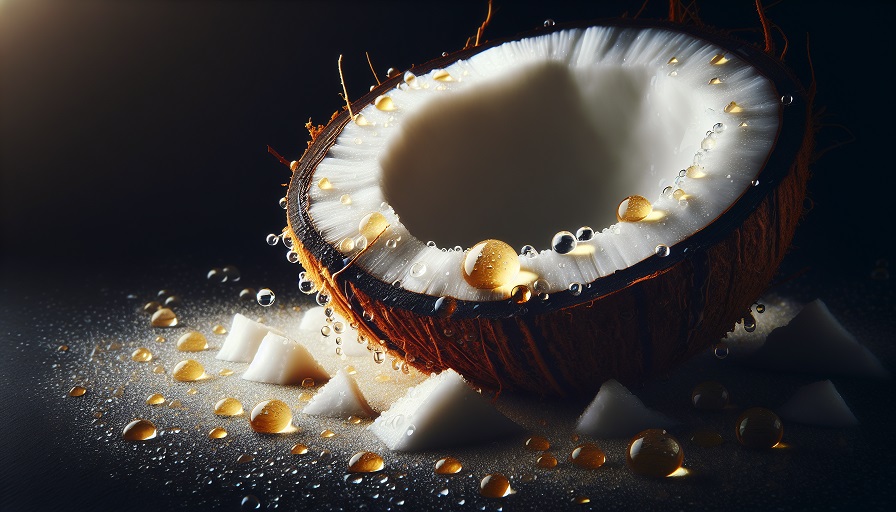
Most people who use MCT oil have a reasonable sense of where it comes from, coconuts, and a general idea of what it does in the body. What gets far less attention is the manufacturing story in between: the sequence of agricultural choices, extraction techniques, chemical processes or their deliberate absence, and purification steps that transform a tropical fruit into the clear, flavorless liquid in a supplement bottle. This gap in knowledge matters because the production process is where the most significant differences between high-quality and low-quality MCT oils are created. Two products can list identical ingredients on their labels while arriving at those ingredients through methods that produce meaningfully different outcomes for purity, potency, and safety.
It Starts in the Coconut Grove
The raw material for most quality MCT oil is the coconut palm, specifically Cocos nucifera, grown predominantly in tropical regions including the Philippines, Sri Lanka, Indonesia, and parts of India. The quality of the finished MCT oil is influenced at this earliest stage by agricultural practices: whether the palms are grown organically without synthetic pesticides, herbicides, or chemical fertilizers, and whether the farming operation is managed sustainably with attention to soil health and ecological impact.
The choice of organic versus conventional farming has implications beyond environmental philosophy. MCT oil is a concentrated fat extract, and fat-soluble compounds including certain agricultural chemicals can concentrate during the refining process. Organic certification provides assurance that the coconuts were grown without synthetic chemical inputs, reducing the baseline level of potential contaminants in the raw material before processing even begins.
From Coconut to Coconut Oil
Whole coconuts are harvested, husked, and either fresh-pressed or dried to produce copra, the dried coconut flesh. The oil is then extracted from the flesh, either through mechanical pressing (cold-press or expeller-press methods) or through chemical solvent extraction using compounds like hexane. Cold-press extraction uses physical pressure without heat above a threshold that would damage the oil’s properties. The result is a higher-quality raw oil that retains more of its natural characteristics and is free of solvent residues. Hexane extraction is faster and more efficient at recovering oil from the raw material, but hexane residues in the finished oil, even at levels within regulatory limits, represent a contamination concern that premium producers avoid entirely.
The oil at this stage is whole coconut oil, containing the full spectrum of coconut fatty acids including the dominant lauric acid (C12), capric acid (C10), caprylic acid (C8), and various long chain fatty acids. This is not yet MCT oil in any meaningful sense. The next stage, fractionation, is where the product differentiation genuinely begins.
Fractionation: Separating the Chains
Fractionation is the process of separating the different fatty acid chain lengths present in coconut oil. It exploits the fact that different fatty acids have different melting points and solubility characteristics, allowing them to be separated under controlled temperature and pressure conditions. The goal for MCT oil production is to isolate and concentrate the C8 and C10 fractions while removing the long chain fatty acids and, depending on the desired product specification, the C12 fraction as well.
Dry Fractionation vs. Solvent Fractionation
There are two primary approaches to this separation. Dry fractionation relies on controlled cooling to selectively crystallize the higher-melting-point long chain fats, which can then be physically separated from the remaining liquid fraction enriched in shorter-chain fatty acids. This is a purely physical process with no chemical inputs, making it the cleaner approach from a product purity standpoint. Solvent fractionation uses organic solvents to achieve a sharper separation of fatty acid fractions, producing a more precisely characterized output but reintroducing the solvent contamination concern that hexane-free advocates rightly raise. Quality MCT producers typically use physical fractionation methods and specify this on their labels or in their production documentation.
The degree of fractionation determines the chain length profile of the resulting oil. Minimal fractionation produces an oil still heavy in C12 because of its abundance in the source material. More rigorous fractionation separates C8 and C10 more completely, producing a higher-performance product but at greater production cost and complexity. This is the fundamental reason why MCT oil products vary so dramatically in their fatty acid profiles: some manufacturers invest in precise fractionation, and some do not.
Distillation: Refining for Purity
Following fractionation, quality MCT oils undergo distillation, a purification process that removes residual impurities, off-flavors, odor compounds, and any remaining traces of unwanted fatty acids or processing residues. Steam distillation and molecular distillation are the primary methods used. Both use heat and pressure differentials to volatilize and separate components by their boiling points, producing a purer and more stable oil with each pass.
Triple distillation, a term sometimes used in quality MCT oil marketing, refers to the oil passing through this purification process three times. Each pass removes additional impurities, progressively improving the purity, clarity, and flavor neutrality of the final product. A triple-distilled MCT oil is genuinely cleaner and more stable than one that has been distilled once or not at all. The absence of off-flavors and odors in a high-quality MCT oil is a direct consequence of thorough distillation, not merely a cosmetic feature.
Why Distillation Affects Digestive Tolerance
The purity achieved through multiple distillation passes has practical consequences beyond flavor. Impurities and residual compounds in inadequately refined MCT oil contribute to the digestive discomfort that some users experience, including nausea and cramping. When these compounds are removed through thorough distillation, the resulting oil is not only more pleasant to consume but also less likely to cause the gastrointestinal reactions that deter some potential users from continuing. The digestive tolerance of a well-refined MCT oil is measurably better than that of a more crudely processed product, which matters considerably for people building a daily supplementation habit.
Testing and Verification
No production process is perfectly consistent without verification, and the supplement industry’s relatively limited pre-market regulatory requirements make independent testing especially important for MCT oil. Quality producers submit their finished products to third-party laboratories for verification of fatty acid composition, microbiological purity, and the absence of contaminants including heavy metals, solvent residues, and pesticide compounds. The results of this testing should be available to consumers on request or proactively published.
Certifications from bodies like the USDA for organic status, the Non-GMO Project for supply chain transparency, and the Clean Label Project for comprehensive contaminant testing provide additional independent verification that does not rely solely on the manufacturer’s own claims. Each certification represents a layer of external scrutiny that adds confidence to the quality picture. When these certifications are missing and test results are unavailable, the buyer is relying entirely on the manufacturer’s word about a product that takes a concentrated and presumably daily place in their nutrition.
What the Production Story Tells You
A manufacturer that is transparent about its production process, specifying organic sourcing, hexane-free cold extraction, physical fractionation, triple distillation, and third-party testing, is communicating something important beyond the specifics: they understand that their production decisions have meaningful consequences for the people consuming their product, and they’ve made those decisions with quality as the priority rather than cost minimization.
The journey from coconut grove to supplement bottle involves dozens of choices that cumulatively determine whether what arrives in your kitchen is a genuinely high-quality nutritional tool or an adequately packaged product that borrows the MCT category’s reputation without earning it. Understanding those choices gives you the framework to evaluate any MCT oil you encounter, and to choose with confidence rather than simply trusting the label’s promises.