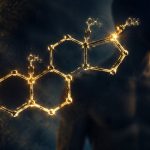
This one deserves an honest, slightly counterintuitive answer. L-arginine doesn’t interact with the hormonal system (the hypothalamic-pituitary-gonadal axis) that actually controls testosterone production, and some research even suggests that nitric oxide, the very molecule L-arginine is best known for producing, can locally suppress testosterone synthesis inside the testes rather than boost it.
Why Nitric Oxide Isn’t A Simple Testosterone Booster
Testosterone is produced through a hormonal signaling chain that starts in the brain and ends in the Leydig cells of the testes. L-arginine doesn’t act on any part of that chain directly. Instead, its well-established role is as the raw material your body converts into nitric oxide, a molecule mainly known for relaxing blood vessels.
Laboratory research on Leydig cells has found that nitric oxide donors can significantly block testosterone production, both at baseline and when the cells are stimulated by luteinizing hormone, the pituitary signal that normally triggers testosterone synthesis. Conversely, blocking nitric oxide production in these cells has been shown to increase testosterone output in some experiments (Welch et al., 1995, Metabolism). This suggests nitric oxide may function as a local brake on testosterone synthesis within the testes themselves, which is close to the opposite of what a lot of marketing implies.
Where Things Get More Complicated
Confusingly, not all the research points the same direction. A study in heat-stressed mice found that L-arginine supplementation actually helped preserve testosterone levels, partly by supporting luteinizing hormone secretion and reducing oxidative stress in testicular tissue. A small study in endurance swimmers also found a modest increase in testosterone alongside decreased cortisol after short-term arginine supplementation, though that study didn’t reach statistical significance.
The likely explanation is that L-arginine’s overall effect depends heavily on context. Under specific kinds of physical stress, its antioxidant and blood-flow-supporting properties might indirectly help preserve testosterone production, while its direct, local effect on nitric oxide inside the testes may lean the other way.
What This Means For The “Indirect Support” Claim
The honest summary is that L-arginine’s connection to testosterone is genuinely indirect and inconsistent, not a straightforward supportive pathway. Any product or claim suggesting L-arginine’s nitric oxide effect directly raises testosterone is oversimplifying, and possibly getting the local biology backward.
Where L-arginine plausibly helps testosterone-related outcomes is more about improving blood flow and delivery throughout the body generally, which supports the tissues that respond to testosterone, rather than increasing the hormone’s production directly.
The Bottom Line
L-arginine’s real, evidence-backed strengths are in blood flow and vascular support, not direct testosterone production, and the nitric oxide connection to testosterone is more complicated (and in some settings, opposite) to what’s commonly assumed. It’s still a reasonable ingredient to include in a broader men’s health formula for its own, separate benefits. Testosil includes L-arginine HCl for this reason, alongside ingredients more directly tied to testosterone production itself.
Frequently Asked Questions
Does L-arginine directly raise testosterone?
No clear human evidence supports a direct effect; its main established role is in nitric oxide and blood flow, not testosterone synthesis.
Can nitric oxide actually lower testosterone?
Some laboratory research suggests locally produced nitric oxide within the testes may suppress testosterone synthesis, though this is a specific cellular finding, not a broad clinical warning.
Should I take L-arginine specifically to raise my testosterone?
It’s not well supported for that specific purpose; its stronger evidence is for blood flow and vascular support.
What ingredients have more direct testosterone research?
Nutrients like zinc and vitamin D, in men who are deficient, have more direct research connecting them to testosterone levels.